Showing posts with label Event. Show all posts

Thursday, March 31, 2011

Fair Trade Event


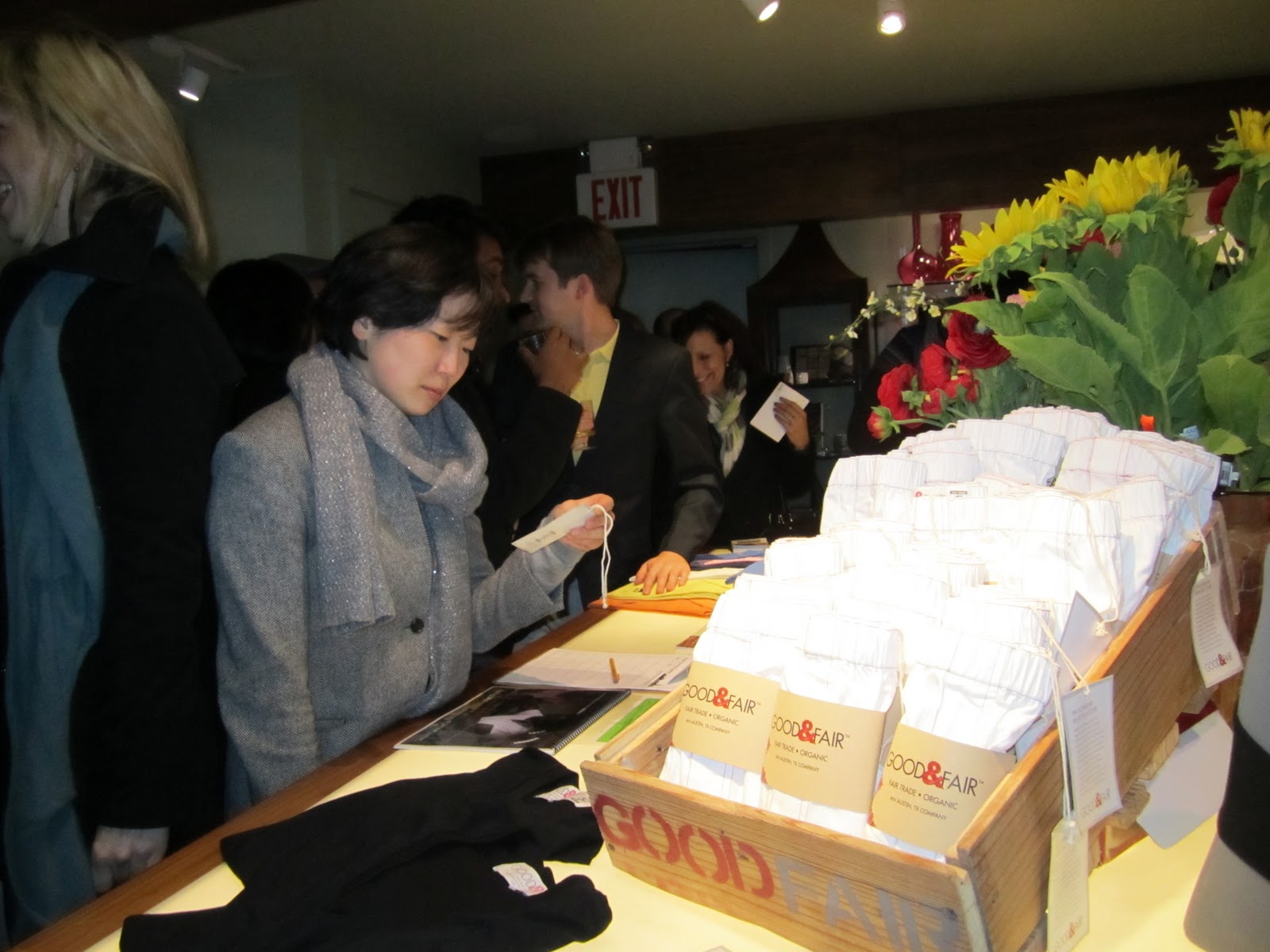
This event took place on Tuesday, March 29, 2011 at Arcadia (Btwn 21 & 22 st. and 8th Ave.) and was hosted by the NYC Fair Trade Coalition.

It was a great event that united fair trade companies with consumers.

About the NYC Fair Trade Coalition: NYCFTC is an all volunteer grassroots organization educating consumers on fair trade and promoting fair trade businesses in NYC. They support and promote discussion around issues of Fair Trade with speaking engagements and events. The event also served as a kick-off for their new "Look Book," which describes the businesses in the coalition. They are currently in the process of mapping stores that sell fair trade products in NYC.  You can visit their facebook page here

________________________

About Arcadia: I have included quite a long description of the store because I found their ideas and values incredible noble and important. You can read the rest of their description on their website.  

After many years of running other people’s businesses, learning how different types of businesses functioned (or didn’t) and realizing that I would never be truly happy working for someone else, I decided to go out my own….“Simple is beautiful” was my response to the complicated, difficult, hectic lives many New Yorkers, myself included, live on a day to day basis. I look for clean lines, functionality, beautiful design, unique product, at reasonable prices that are ethically made. I aim for a broad enough selection that most people can find exactly what they need while still maintaining a sense of continuity throughout the store.

"...While the highest ethical conduct may not always pay off financially, it always pays off in far more important ways."
...I had the tag line “simple is beautiful” set in my head, but was rather lost on what to actually call the store….Thankfully, my best friend immediately suggested Arcadia, from James Joyce’s “Ulysses” which he was reading at the time. I immediately loved it; it is graphically balanced, begins with an A (important for phone and web listings), and most importantly, the Oxford English Dictionary definition of Arcadia is “a simple, pastoral way of life. Heaven on Earth”. Clearly, it was meant to be. 
Arcadia’s core values We strive to offer our customers a peaceful, pleasant shopping experience where our customers will find helpful, friendly employees who are attentive, informative and knowledgeable about the products we offer. It is important to us that everyone feels welcome and comfortable at Arcadia, regardless of their budgetary constraints or interest in purchasing anything at all. We aim to be patient, helpful, respectful and polite to everyone, and hope for the same from our customers.
Arcadia focuses as much as possible on fairly traded products made throughout the world, so that our customers’ interest in supporting indigenous populations and their cultures can be achieved. We also try to limit our impact on the environment in the following ways;
  1. We recycle as much of the packaging materials we receive from our suppliers as possible by reusing them for our own shipments, as padding for gift packaging, offering free packaging materials to customers who can use them, and paying for recycling of our own garbage. We also regularly lobby our suppliers for greener packaging solutions, referring companies to each other so they can share information on reducing their packaging. We routinely ask customers who already have shopping bags if they would like to skip a bag for their purchase at Arcadia, although we happily supply shopping bags for all purchases regardless of size.
  2. Arcadia uses 100% wind energy for electricity, through the Con Edison Green Solutions program. Our track lights are a special infrared variety that reduces their energy usage approximately 20%. We also use LED and fluorescent lighting where ever feasible. The entire façade of the store uses double paned, insulated UV glass, specifically designed to reduce heat transfer as well as noise, which reduces our need for air conditioning in the summertime and insulates us so well from the cold in winter that we rarely run the heat in the winter. Our electronic thermostat is programmed to keep the store at a mild 73 degrees all day during the summer, at 74 during the winter, shuts off automatically when the store closes at 10PM, turning on in the morning just in time for opening. Because natural gas dryers are more efficient than electric dryers, we use gas for our dryer, which along with our washer is EnergyStar rated. We also try to run our appliances with larger, therefore more efficient, loads later in the evenings when energy demand is lower.
  3. We have resisted the retail trend towards plastic coated, heavy shopping bags. While we understand that many customers reuse such bags, they are non-recyclable due to the multiple layers and materials involved. Our paper bags are made of 30% post consumer waste and are recyclable with other paper products. We offer plastic bags (saved from my grocery shopping at Gristedes) only during heavy rainstorms as needed to protect our customers’ purchases from the elements. Our gift boxes are made from 100% recycled paper and are recyclable, as are our tissue papers and heavy craft paper. The fancy gift wrap, while not made of recycled papers, are recyclable. We are currently investigating switching suppliers for our jewelry boxes to a Rhode Island based company which uses 100% recycled materials to replace our current suppliers which are based in China and are mostly non-recycled and only partly recyclable.


THE VENDORS


Ahkun
Blog   Twitter   Facebook
About: Ahkun means 'thank you' in Khmer (Cambodian). We work with entrepreneurs who have received microloans to further their skills and build better lives for themselves, their families, and their communities. We connect them to the global marketplace---creating sustainable businesses and closing the gap between microfinance lenders and borrowers, consumers and producers.
Fair Trade Spirits

About
:  FAIR. announces the rise of transparent and sustainable ethics in ultra premium spirits. By associating the best French distillers to local cooperatives in the third world, FAIR. aims at bringing to the consumers the finest spirits possible produced from fair-trade ingredients. We believe in showcasing in the most transparent way all the human capital that goes into making unique ultra premium spirits.
In 2009 the Fair Trade Spirits Company launched FAIR. Quinoa, the first Quinoa-based Vodka but also the first fairtrade certified™ vodka in the world. FAIR. Quinoa has been awarded twice last year as one of the best Vodka in the world. In 2010 they completed the line with FAIR. Goji made from the legendary, sacred Goji berry fruit. FAIR. Goji is the first Goji Berry Liqueur and is fairtrade certified™. FAIR. offers the latest sources of inspiration for fresh, healthy and generous cocktails.

Global Goods
Blog   Twitter   Facebook
About: Global Goods Partners is a not-for-profit organization dedicated to empowering women, alleviating poverty and promoting social justice. We partner with community based organizations in marginalized regions of Asia, Africa, the Americas and the Middle East, creating access to the U.S. market for our partners’ handcrafted products and providing technical assistance to build sustainable livelihoods.

Itzso

The models sported apparel
from multiple vendors.
About: We are a fair trade fashion company that collaborates with innovative artisans from developing countries to create unique handmade accessories and apparel.

Kono (Google Translate English Version)
Blog (English)   Facebook
About: Kono Business is a business concept that aims to tailor marginalized women in Sierra Leone produce scarves and handbags designed by Danish designers.

Of Rags
Blog   Twitter   Facebook
About: Of Rags is a fair trade fashion cooperative for sustainable community development. 40% of the profits from each sale directly support public health and education initiatives. The remaining proceeds are used to grow the company to achieve the greatest impact.

Tompkins Point Apparel
Blog   Twitter   Facebook
About: TOMPKINS POINT APPAREL is a unique brand dedicated to ensuring that every person who plays a role in producing our clothing has a better life because of our business. To do this, our clothes are certified fair trade and organic and we donate 25% of our profits directly to the people who make our products. We're proud of our shirts and what they represent, and we'd love for you to take the time to learn more about us.

Via Nativa
Blog   Facebook
About: After seeing the talent and abundance of artisan crafts in Nicaragua, and understanding that it is not only an art but very much a livelihood, Alessandra Plasa and Vanesa Natale started a fair trade and environmentally friendly business. Alessandra now runs the business with a focus on sustainable wood jewelry among other accessories and works directly with artisans and women owned co-ops in Nicaragua.

___________________________________________

Questions for Consideration
The following commentary is a combination of my own ideas and those expressed to me by other attendees of the event. 


1. How useful and reliable can third party certifiers (like Transfair) be for verifying and marketing the fair trade fashion industry?

Overall: Very helpful. 
Despite varying criteria for these certifiers, they are helpful in educating consumers about products and in starting a discussion. Jay, the owner of Arcadia, told me that third party, and even second party, certifiers are better than nothing and mean that we're moving in the right direction. We have seen these certifiers pop up in many industries, and they were also a topic for discussion at the SPN Panel on Green Consumerism and the Slow Fashion Meetup
NYC FTC is in the process of creating an online database for stores that sell fair trade products, and their own seal of approval. This event was a show case for their new "Look Book," a collaboration by the sellers of NYC FTC to raise awareness about their products. 


2. Will people be willing to spend more for fair trade products with our current mindset of extreme materialism?
Fair trade products do, sometimes, cost more than others. As described in The Story of Stuff by Annie Leonard and The Trust Cost of Food by the Sierra Club, some of the products we buy are impossible cheap, meaning that the real cost is not put on us but on other countries, cultures, and the environment.

3. How [much] can pressure from social media and potential publicity from Corporate Social Responsibility campaigns help grow the Fair Trade industry?
Overal: Immensely
Social media, and the internet in general, provide a vital information source for discovering supply chains and then spreading the information about irresponsible practices.  Sustainability and fair trade practices are now being used as marketing tools by companies, and are slowly being demanded by the customer and employees.
I have found a general shift between businesses and organizations to a middle ground. Businesses are using fair trade standards to create positive change, and organizations use a business model to increase revenue. I imagine that this will now become a growing trend, in which companies move to look more at the triple bottom line. Most of the companies represented at the event have a large charitable component to them. Of Rags has a very interesting situation in which they have both company and 501c3 status to work in both sectors.

4. How can the fair trade and slow fashion industries combine to increase purchase of sustainable clothing items?
Both the fair trade and slow fashion industries are working to reduce our overly consumeristic mentality and increase our appreciation of materials and where they come from. They are similar movements, although focusing on slightly different areas. They both represent ideas that are crucial to developing a sustainable culture and civilization.

5. In a time when consumers are growing further and further from the source of their purchases and where they go once they are thrown out, how can be we bring people back to look at all levels of the supply chain?
Both the slow fashion and fair trade industries are working to increase awareness of the supply chain. Websites like sourcemap.com and third party certifiers are also working toward this end. Our current mentality of materialism is a relatively recent development but will take time to move away from. Increased awareness about where all of our things come from and go once they are disposed of will help customers "vote with their dollar" for responsible items.

6. How is the U.S. doing in relation to the rest of the world on the mission of Fair Trade? How do different cultures react to the concept?
I heard mixed opinions on this topic. Some say that the U.S. is behind the EU in terms of awareness of fair trade and the source of products. Others say we are keeping up. I believe we are behind. America's mentality has always been freedom and materialism. The freedom aspect gives many the excuse to say that they will buy which ever products please them (in a slightly entitled way often). The materialism aspect can be easily seen in the ideal of the American Dream - owning a home [and competing against our neighbors for "more stuff"]. Cultures that have more of a history of slowing down, such as Italians with their ideal of Dolce Vita, are, in my opinion, more receptive to these fair trade and slow fashion movements.

I will repeat one of my favorite quotations from the documentary "The Economics of Happiness": 
"You cannot have infinite growth on a finite planet."
It is essential to keep this in mind when moving toward a more sustainable culture.

Now it's your turn to weigh in: What do you think about the questions above and the fair trade movement? Do you have any favorite fair trade stores?

Wednesday, March 23, 2011

Green Home NYC Forum: Sustainable Storm-Water Management

This Meetup took place on Wednesday, March 16, 2011 from 6:30-8:00 at the Toto showroom at 25 Mercer St. (btwn Canal and Grand) and was hosted by Green Home NYC.

You can view this page for more information on the speakers.

Speakers:
Jack Coogan - Building Scale Solutions: OCV Architects
Coogan is the RA and Principle at OCV Architects and spoke mainly about one specific project in the Bronx. The building consists of 18 units and his company reduced construction costs enough to install a rainwater collection tank. Calculating using NY's average annual rainfall of 49.7 inches, the roof's area of 2850 square feet, and a 95% capture rate (for a total capture of 80,000 gallons), they figured that each apartment could flush their toilet 9 1/3 times per day just on the grey water collected. After completing the project, however, they found that each unit actually flushes their toilet 25.5 times per day! So, the grey water mixes with fresh water to make up for the difference. With 1 cent per gallon water costs, and 1.3 gallons per flush, Coogan calculates an $800 per year savings (it is worth noting that the system cost $18,000 to install - 12 year pay back). 


Susannah C. Drake AIA, ASLA - Rising Currents: A New Urban Ground
Drake spoke of a project she worked on with Stephan Cassell and Adam Yarinsky on the infrastructure issues that will result from sea level rise (climate change) in NY Harbor. They were one of five teams to participate in the challenge to create a solution to projected sea level rise of 6 ft (plus 18 feet for a storm surge). Each team was assigned one spot on the NY Harbor, her team focusing on the 500 acres that comprise lower Manhattan.  Their calculations revealed that 21% of lower Manhattan will be covered in 100 years, with 68% susceptible to the storm serge.
We currently dump 500 million gallons of sewage water into the harbor each week! Their plan consists of permeable street beds with water proof vaults for cables and other lines. The tip of Manhattan would become an urban estuary (close to a swamp) and the east side would become a salt marsh with an urbanester and a sunken forest.
You can read more about the project and view photos at the dlandstudio website and on the MOMA page.

Tatiana More - Stormwater: Waste or Resource
More spoke about CSO, or Combined Sewage Overflow. She also shared a theme I have found particularly relevant in my recent blogging and exploration of the sustainability field - that there are "Silos of information, but no conduits." 
According to More, the MTA uses 2.6 Billion gallons of potable water per year! The water filtration system was built on a plot of land with a high water table which had to be subsequently drained and then refilled - a huge waste! These two examples show some the inefficient manor in which things are done in NYC.
Her program, the NYCSWCD, works in consort with the SWIM coalition and measures soil moisture saturation, evapotranspiration rates, and does pollution analysis of their water absorption projects to find the most efficient solution for a specific area. She gave some details on specific projects they have done recently.


Thomas O'Connor - Stormwater Solutions REsearch: EPA Office of Research and Development
O'Connor works in the water supply and water resources division of the Urban Watershed Management Branch of the EPA. He works on management of wet-weather flows and the aging water infrastructure. The New Jersey office of R&D is 20 acres on which models are tested for optimization.
He spoke specifically of two projects they have recently worked on - one for semipermeable parking lots, and the other for green spaces which are meant to absorb extra water.
Sustain is an online decision optimization engine used by his office. 


Questions for Consideration:
  1. How can we encourage CSR like that being practiced at Toto to come from all companies?
  2. How can we get people to understand the resources their using when they don't see where they come from and where their waste goes?
  3. Do we need to completely redevelop our infrastructure? 
  4. What can we do about diverting more of NYC's sewage from the ocean?
  5. How can we communicate the level of urgency to the people who just don't care?

About GreenHomeNYC:
"The Green Building Forum is held on the third Wednesday of each month (except December) at 6:30 PM and features presentations by green building practitioners followed by discussion. The events are always free and open to the general public."


About Toto:
"TOTO is the world’s largest plumbing products manufacturer. We offer a complete line of commercial and decorative plumbing fixtures and fittings, faucets, accessories, shower and flush valves, as well as lavatories, toilets, Air Baths and urinals. More than 1,500 TOTO engineers and their colleagues are committed to achieving the seamless integration of performance, conservation, technology, and innovation.
For over 90 years, we have been producing superbly designed, high performance lifestyle enhancing plumbing products for residential bathrooms and commercial restrooms. While we understand our customers want products that have great design, we concentrate on creating a more enjoyable bathroom experience through products that infuse sophisticated style with substance, optimize water conservation and provide consistent, exceptional performance.
For example, TOTO embraced water and energy conservation years before government mandates. Through our constantly evolving manufacturing practices and advanced technology, we consistently lead the way in plumbing fixture efficiency and sustainability. Advanced innovations such as our EcoPower® fittings and valves, and our highly active participation in and support of the United States Green Build Council (USGBC), have made TOTO a world leader in plumbing products that have helped to advance society and help protect its future at the same time.
Our state-of-the-art plant in Morrow, Georgia is a testament to conservation and quality control. For example, we recycle the water we use as well as thoroughly treating it before returning it to the county. From our molding process to the final changes, our products are constructed and fine-tuned with computer precision and relentless attention to detail. Our pursuit of excellence pushes us beyond industry standards and drives us to maintain our reputation as one of the most decorated plumbing manufacturers in the world.
After nearly a century of experience, we are committed to maintaining the perfect balance of form, function and design. TOTO is Luxury in Balance."

Friday, March 18, 2011

SPN - Green Consumerism: Behavior or Myth?

This Meetup took place on Tuesday, March 15, 2011 at Baruch College / CUNY, William and Anita Newman Conference Center, 151 East 25 Street (btwn Lex and 3rd) NYC.


"In a world where greenwashing accusations run rampant and green purchasing seems a fickle, niche trend at best, green products and consumers have continued to evolve for the 21st century. Today, sustainable products and their corporate manufacturers must not only surpass business as usual regulatory requirements, but also perform as well or better than traditional products. Meanwhile, green purchasers, once limited to eco-conscious environmentalists, have broadened to include much wider demographics, especially as Lifestyles of Health and Sustainability (LOHAS) marketing has generated an over $200 billion U.S. industry comprising nearly 70 million consumers. No longer limited to ecolabels and recycled packaging, green marketing strategy must successfully juggle product eco-innovation, brand identity, corporate CSR, and interactive communication in an authentic, transparent, and creative way- a feat that is easier said than done.
Join the Sustainable Practice Network’s experts as they explain changing consumer attitudes and behaviors around sustainability, how compelling campaigns frame sustainable products, and the dos and don’ts of green product benchmarking. Hear their predictions for the future of sustainable product development and green marketing and find out whether “green consumption” is myth or reality."

Speakers:
Jacquie Ottman, Moderator
Ottman was a fabulous moderator who put in her two sense while asking stimulating questions and making connections to tie topics together.  She started out with the statistic that "83% of consumers are some shade of green." Baby boomers on up have grown up with the concept of green in their conscience. (She has some more incredible statistics on her blog) But there has been a dark side to this market. Some companies, and even organizations, have been accused of making misstatements and selling out. In this panel, the goal was to answer three main questions:
  1. Who is the green consumer?
  2. How big is that market?
  3. How can we keep the market for green product moving?
Ottman also pointed out that there are many components to green products. Just as the recycling symbol has three arrows to represent collection, processing, and marketing development, green products need to be not only produced responsibly, but must also be used and disposed of in an environmentally conscious way.  
Another key concept that came up over and over is that trust is the biggest part of marketing, and, at the end of the day, consumers trust their friends and family over anyone else. 


Daniel Katz
"Daniel R. Katz is the Senior Program Director at The Overbrook Foundation where he leads the Foundation's environmental giving in the areas of international biodiversity conservation and sustainable consumption and production. He is the Board Chair and former executive director (1986-2000) of the Rainforest Alliance, an organization he co-founded at the age of 24. The Rainforest Alliance works in over 70 countries and has a budge of nearly $40 million."

David Mallen
David G. Mallen is the Deputy Director of the Better Business Bureau's National Advertising Division (NAD). Before joining NAD, Mallen practiced law, business counseling and commercial litigation. He is an experienced trial lawyer with a background in biological science. 

Josh Parker
Parker is the COO at VerTerra, a company that makes dinnerware from compacted leaves. The company has corporate, social, and environmental responsibility deeply embedded in its mission. 


Questions for Consideration:


1. What roles does social media play in green consumerism?

2. What role does corporate social responsibility play in the expansion of the green market. 

3. Is relying on a third party certifier a good policy?
Parker: No - Trust is the key, and recommendations are far more valued from friends than from third party certifiers.
Mallen: Yes - Third party certifiers are helpful, but we need to have caution when relying on them because not all certifications are equal.
Katz was in the middle. It depends on the customer (in Europe customers tend to be more educated) and the industry. But, in general, companies and non-profits tend to be moving towards a middle ground: companies are taking CSR and double and triple bottom line into account and non-profits are using business models to raise money. 

4. Should minimum green standards be put in place?
For minimum green standards to be required, the customers have to demand it. Companies want to be leaders, not followers because they need to drive demand. There also needs to be transparency of information and trust marks must gain value. The FTC just updated its standards for green packaging. However, the FTC does not make regulations or enforce them; it makes guidelines and definitions for how companies are allowed to use terms in order to avoid false advertising. 

5. What are the biggest mistakes companies make with green marketing?
The biggest mistake tends to be over-enthusiasm - companies take a small step and then make a general claim. 
Often companies use a reverse process, thinking about how they can say their green before doing the small actions that will have the biggest PR impact.
Companies should also talk about where they fall short because it can help build trust between the advertisers and the consumer. 

6. Should there be a ratio on how much money companies can invest in product development to how much they can spend on advertising?
No - This could potentially limit small businesses, but an interesting concept.

7. How can we make life-cycle assessment by the consumer possible? Should labels list total resource usage such as gallons of water and carbon emissions? How can bar code apps help with the transparency of this information and create a more informed consumer? 
Resource labels have been considered, but may actually cause more packaging. Bar code apps are helpful, but don't tell the whole story and aren't a solution. The Good Guide is a great example of one of these bar code apps. 

8. Do regulations impede or help? 

9. Why is California ahead of NY?

10. Why is there a gap between the U.S. and Europe?
This is really because Europeans (in general) have smaller apartments and don't have lawns. While these are generalizations and so is the question, there do seem to be cultural differences that make the green economy very different. 
Katz: In Europe, people tend to do things for the greater good, while the U.S. is focused on me me me, my way or the highway, and "no one's going to tell me what type of light bulb to use!"
Mallen: The first amendment is incredibly prominent in U.S. culture. This give companies the freedom to innovate in terms of their marketing, etc.

11. Levi's WaterLess Jeans
Levi's new jeans brand uses 96% less water. The logo is confusing - it can easily be read in a way that implies that the jeans take no water to produce, but the it really mean that they use less water. The entire audience ended up agreeing that it is an unauthentic marketing campaign. First of all, which part of the supply chain are they starting at? Because cotton is a crop that takes an incredible amount of water and pesticides to produce. Next, it was pointed out that 20 or 30 years ago, jeans were made with hardly any water (and that's why they were so still). So, is Levi's making jeans with 96% less water than their most recent brands or ever? It might even be the case that they are using more energy or being less environmentally friendly by not using the water. Andthe information below from the website shows that some jeans on this line save as little as 28% of water.


Levi's® Wants to be Part of the Solution

Levi's® believes that it is important to take action because we're part of an industry that depends on water. An average pair of Levi's® jeans needs 42 liters of water to be dyed, washed, and finished. Once we take them home we use even more water caring for our jeans using 21 liters every time we wash. That's 4 times the amount of water someone in a developing country might use for an entire day's drinking, cleaning, cooking, and washing combined.
Building Better Product
The Levi's® brand is offering one way to address the water used in our part of the equation: Water<Less™ jeans. Water<Less™ jeans reduce our water usage by an average of 28% per pair--and up to 96% for some styles. It's not going to fix the problem, but it's a step in the right direction, and one that we're committed to as we're increasing our Water<Less manufacturing.
But We Can't Do It Alone.
Starting March 2011, we intend to provide access to excess; we will provide clean drinking water to communities in need around the world, and we need your help distributing it.
To join us in caring for the planet please sign up below.
12. Should companies have a sustainability manager, and, if so, what department does he/she work under?

13. How do we educate consumers about the true cost of products (True Cost of Food) when it is extremely rare that they see more than their own usage of the product (no one sees where their product comes from or goes).

14. 85% of Americans think corporations have too much power (Annie Leonard - Story of Citizens United vs. FTC). How can these corporations use their power to influence government in a good way to increase green infrastructure and support a green economy?


"Established in 2004, the Sustainability Practice Network (SPN) is a New York-based interdisciplinary community of professionals who seek to learn and share knowledge to advance sustainable development across sectors and disciplines. We mobilize our members to practice sustainability in their lives and work. Our mission is to raise awareness of the importance of individual and corporate sustainability and thereby create a more stable and equitable world."


If you have any comments or questions please leave a comment below.

Sunday, March 13, 2011

Wild and Scenic Film Festival

The Wild and Scenic Film Festival took place on Wednesday, March 9 at the LGBT Community Center (208 W. 13th St., NYC) from 6-9 p.m.

The event was put on by the Green Guerillas and sponsored by Sierra Nevada, Patagonia, Osprey, Klean Kantene, Grist, and Clif Bar.

In total, 9 documentaries and short films were shown. The event was flawless. The movies were all fantastic and fit together well. Representatives from ioby, Dissent Magazine, and some other local organizations were also present.

Bike-U-Mentary
This was a well put together documentary by students at UCLA. A nice film, but not a must-see. You can watch it below.


Witness
This is an absolutely stunning documentary about conservation photography. The pictures are beautiful and the interviews are informative. Overall a must-see! Watch the trailer below.


Animals Save the Planet Shorts
Cute and funny animated shorts about animals and the environment. Great for children and a quick reminder that everything we do affects the planet we share.


They did not show the one below, but it includes 5 similar shorts. I think it would be great for showing to younger kids.


Brower Youth Award Shorts
These are on YouTube as well, although I didn't find the specific ones they showed at the film festival. Below is one on Alec Loorz, an incredible young adult from California whom I had the pleasure to hear speak in 2009 at SC3.


Save the Farm
This is the incredibly moving story of a community in California trying to save their 14-acre urban garden. I highly recommend this film - must-see!


Oktapodi
A quick, cute film. You probably won't be able to eat calamari after this one!


The Majestic Plastic Bag
This 4-minute mockumentary is just fabulous.  I even showed it to some non-yet-environmentalists who found it funny :) Also a must-see! The full movie is below:


The Windmill Farmer
I found this one to be just all-right, not great. The animation is clearly very well done, but I wasn't as moved by the story. You can watch it below.


Truck Farm
Ian Cheney brings you another fabulous documentary. This time, quite goofy, but informative and interesting nevertheless. Cheney was at the film festival and answered questions after his movie. If you're not already an Ian Cheney fan, you will be after this film!


You can check out my YouTube channel for more great videos.

Sunday, February 27, 2011

The Ecovillage Movement


What is an Ecovillage?

"Ecovillages are urban or rural communities of people who strive to integrate a supportive social environment with a low-impact way of life. To achieve this, they integrate various aspects of ecological design, permaculture, ecological building, green production, alternative energy, community building practices, and much more.
Ecovillages are living models of sustainability. They represent an effective, accessible way to combat the degradation of our social, ecological, and spiritual environments." -Global Ecovillage Network webpage

What is an
Intentional Community?
"Intentional Community is an inclusive term for ecovillages, cohousing communities, residential land trusts, communes, student co-ops, urban housing cooperatives, intentional living, alternative communities, cooperative living, and other projects where people strive together with a common vision." -www.ic.org

This event took place on February 19, 2011 at
Bluestockings in NYC. (As a note, Bluestockings is collectively owned, so this model of community can be found in many more forms that one may think.)
Speakers:


1. Steve - Ithaca Ecovillage
The Ithaca Ecovillage has 2 co-housing neighborhoods (known as FROG and SONG) and another one in progress (which will be called TREE) on 70 acres of an ex-farm in Ithaca, NY. They have a 'U-Pick' berry farm, a large organic vegetable farm, and a pond (for fire protection).  They serve common meals a few times a week in the common houses, although each house has a small kitchen of its own. Members of the community recently built four solar ovens for collective community use, and they also share duties such as composting and laundry service. They have a cooperative government, which makes decisions by concensus and a village association that weighs in on all matters.

2. Susan Grossman and Michael Johnson (Founders, Ganas Community, 1980)
The Ganas community is located in Staten Island, NYC - showing that ecovillages are possible even in urban environments. They now have 8 houses with 75 people living as a "self-selected extended family." Their economy is based on the furniture store, art gallery, clothing store, book store, and thrift shop (creatively named "Everything Goes"). The core group shares everything including income, and the extended core group shares everything but income. The Core group meets for an hour and a half five days a week to discuss everything from planning the day to bigger issues. They have a "no non-negotiable negativity policy" to help prevent and resolve conflicts. Most couples have their own room, although a few share.


The ecovillage movement is about creating a sustainable lifestyle - not just environmentally sustainable, but in all aspects of life. Both of these ecovillages are open to visitors, typically on Fridays for their open community dinner. Contact them to arrange a visit.

Although the ecovillages presented above are secular, there are many IC's that are religiously based. They often run on different systems of self-government.

Questions for Consideration:
1.  What types of people do you see in these communities?

The speakers' answers: Nonjudgemental people, not controlling people, people who want to be around others but have trouble initiating connections, middle class. 
These groups are mainly made of middle class residents because the middle class has had the biggest loss of community. 
They also added that most ecovillages are entirely accepting of diversity.


2. What is your vision for the future of eco-villages? 

Obviously massive eco-villages cannot take over the country or the world because the whole concept of an ecovillage is that it is a small group of people working together (we've seen that this model does not work on a larger scale - communism).  
The speakers would love to see more ecovillages pop up around the country and the world. 


3. How would an expansion of the ecovillage movement change the role of the government?

The speakers' answer - it's too soon to tell. Expansion of the movement would take quite a while, so it is hard to tell what the state of the government would be at that point. 


4. Expanding the ecovillage movement is difficult and radical: how can we start changing the current mindset of materialism and the 'more is more' attitude that is infecting our country and the developed world? 


This is a difficult question, and, unfortunately, I wasn't able to ask the speakers for their opinions.
This is the topic for Annie Leonard's incredible series of videos
"The Story of Stuff." (Watch the videos here.)

Let's continue the discussion! Write a comment below to share your opinion on the topics presented above.

Wednesday, February 23, 2011

NYAGP Green Expo and Talks

This event happened on Tuesday, February 22, 2011 at 6:15 at Amber (432 6th Ave., NYC)

About NYAGP: New York Association of Green Professionals was launched in November 2010 by Pankaj Gupta and has quickly grown to 185 "Green-tech lovers." Pankaj's goal is to
“We want to help small business in growing and developing. NYAGP is committed to make their products / services more visible through this event and it`s distinct features such as 'Green Expo' and 'Presentations'.”
`NYAGP is a distinct platform which provides great networking and learning opportunity to Green Professionals through conferences and networking events. 
NYAGP also helps innovators and entrepreneurs get their idea commercialized by providing help in finding a well- balanced team, writing business plan and generating seed funding.
Here are their sites:
Meetup (main site)
Facebook
Twitter

Their next Meetup is already scheduled for March 26 - check it out here.

Last night's event was mainly networking with 3 presentations in the middle. The following is my summary of the presentations.

1. Brett Anitra Gilbert, Ph.D. (Texas A&M University, Rutgers University): Challenges for Entrepreneurs in the Commercialism of Green Technologies
Brett Anitra Gilbert has a background in hydrogen fuel cell technology. Once she began to see how useful fuel cell tech. is, she wondered why is wasn't more widespread. Her presentation was aimed at showing the challenges faced by creators of green technologies in marketing their products. These challenges were divided into market challenges and then business challenges. (Arrows represent her ideas for solutions.)
  1. Lack of awareness of the environmental problem --> Educated the market place
  2. Apathy (people just don't care) --> Make the products convenient
  3. Cost (new products are ore expensive because they are not yet produced on a large scale), and limited value proposition --> Marketing
  4. Lack of infrastructure to support new technologies / insufficient supply chain (limited number of suppliers who control the market and can increase prices) --> Create aftermarket support
  5. Competing technologies (people don't understand the uses) --> Education
  6. Politics! 
    • Gilbert's claim was that the government is constantly changing preferences, like flavors, each year, so each year investments from the government shift. 
    • Big business prevents new technologies from coming up --> Entrepreneurs need to plug into their trade association to have support and lobbyists on their side. 
Questions for consideration:
  1. How efficient is hydrogen? (At the moment it is still being produced by coal plants, which is horribly inefficient.)
  2. How can we get past U.S. government subsidies for big business?
    • At the moment big business has so much control over the government that they effectively push down new, sustainable technologies because they fear the competition. 
    • Gilbert's answer was that only time will let this pass. If the people make a change in demand, then businesses will follow. However, I don't think this can come quickly enough. We need the government (not lobbyists) to step in and take control of the situation: to promote sustainable technology, and take away power from big business. 
    • Her other answer was a carbon tax. [My opinion] Carbon taxes have been widely supported, but big business is not going to tax itself, and, at the moment, they likely have too much power for the government to side-step them. In Maryland a carbon tax was imposed that was above the carbon output. When carbon output fell the tax remained at previous levels and was completely ineffective. 


2. Scott Van Pelt, LEED GA, Urban Green Energy: Advances in Small Wind
Since the first wind farm was started in New Hampshire in 1980, the wind turbine industry has been growing. Wind turbines use wind to move the coils of a generator rather than the traditional method of steam. There are 3 types of wind turbine - Horizontal axis (which whistles), the Savonious type, and the Darrieus type. The latter two are both on a vertical axis. Pelt's company, Urban Green Energy installs Darrieus type turbines on a small scale.

There are 3 things to consider when setting up a wind project: swept area, siting, and battery vs. grid tie. And there have been quite a few advances to the wind industry recently - venture capital funding is increasing, the federal government has increased funding, universities are creating majors based on sustainable energy, and improved siting technology.

It is also important to consider buyer motivations for wind energy: 1. living a more sustainable lifestyle (for the true tree-huggers among us) 2. LEED/marketing and Corporate Social Responsibility for businesses who want to have a 'green image' 3. Return on investment.

So, why wind? There are a number of benefits to wind energy: 1. Wind can be harnessed almost anywhere 2. Wind turbines have a smaller footprint than solar (claim by Pelt, although I am not sure of the data for this) 3. Lower cost 4. Wind-solar hybrid systems (these are very useful because on nice days it is sunny but not windy, and during storms it is windy but not sunny etc.)

Questions for consideration:
  1. What resources do we have here in NYC?
    • Wind is relatively viable in NYC and there are a few companies
    • Urban Green Energy is launching a pilot project in the Bronx


3. Christine Vescovo: Greensulate
Greensulate was founded by Amy Norquist and has won many awards. They focus on designing and creating green roofs and make very individualized projects. They work with the New York Restoration Project. Normal roofs have to be replaced every 10-15 years, but green roofs can last up to 100 years!
About Greensulate: "Greensulate is on the leading-edge of integrated design, engineering, installation and maintenance of Green Roof Systems for the residential, commercial, and industrial markets as well as public & private institutions. We partner with architecture firms, conventional roofing contractors, engineers, real estate owners & developers and facilities managers across the U.S. to design highly customized Green Roof Systems, manage their installation, and offer important on-going maintenance services. All Greensulate Project Managers are certified Green Roof Professionals (GRP’s) accredited by Green Roofs for Healthy Cities." 

__________________

Overall the event went very smoothly. It was great to be able to talk to everyone, rather than the general format in which everyone sits down and listens to a few panelists and then leaves without having connected. I think this sort of even will be very important for connecting the environmental community and increasing collaboration. 

Wednesday, February 9, 2011

Gasland Screening Tonight


Tonight there will be a screening of the documentary Gasland at the Dalton School in Manhattan, NYC.
I will be at the event and look forward to writing a blog post about it afterward.

Wednesday, February 2, 2011

Upcoming Rally Against Wal-Mart in NYC

Thursday - Feb. 3: Rally Against Wal-Mart by the Times-Up Organization http://times-up.org/calendar/detail.php?calendarid=3107


There will be a bike ride ending at City Hall where supporters will rally against Wal-Mart.