The new EOS website has just been launched - including the next EOS question!
Experts' Opinions on Sustainability Website
Saturday, June 4, 2011


Thursday, May 19, 2011
World Fair Trade Day at Sustainable NYC
The New York City Fair Trade Coalition hosted a great event on Sunday, May 15 to celebrate World Fair Trade Day! Located at Sustainable NYC in downtown Manhattan, the event featured booths from fair trade companies where visitors could learn about the story of their products. And that's a really big part of Fair Trade - bringing the consumer back to the production and increasing appreciation for the resources and labor that went into it. These booths were in addition to the incredible stock of fair trade and sustainable products Sustainable NYC carries daily.
Below are a few photos I took at the event.


 |
| Eco Friendly Nail Polish - I've been looking for this! |

Wednesday, May 18, 2011
Women Concerned About Health Risks Yet Lack Knowledge to Promote Wellness at Home
The following is an interesting commentary from Maid Brigade and GreenCleanCertified.com. Despite its plug for Maid Brigade, it is a great report on indoor pollution.
"Roughly half of women worry about cross-contamination of germs when cleaning and lack confidence that their home is sanitary, according to a new survey conducted by Maid Brigade and Mom Corps. Despite elevated concerns about the safety and health of their home environments and the recent Environmental Protection Agency (EPA) warning that indoor environments are two to five times more polluted than the outdoors, only 27.8 percent of total survey respondents say a 'healthy safe environment' is their primary motivator for house cleaning.
To help consumers become aware of invisible indoor air triggers that can cause potential health risks like asthma and allergies, Maid Brigade has released an educational video (greencleancertified.com/greentv) to show how green cleaning can help improve indoor environments. The video explains how to reduce the impact of allergens in the home including combating dust mites, mold, and pet dander and eliminating the detriments to household air quality that chemical fumes from cleaning products and spray air fresheners can also present."
Thursday, May 5, 2011
The End
This marks the end of the official project of The Green. I started this blog as an independent senior project for my final semester in high school and was exempted from two of my classes in order to pursue a total immersion in the environmental blogosphere. A 20 page paper on the blogging process is due on Monday, and I will give a 30 minute presentation on Thursday, May 19.
This has been the most incredible project I have ever done! It has further sparked my interest in the fields of environmentalism and sustainability. I am excited to keep blogging over the summer and to continue my education on these subjects next year in college.
Thank you to the readers, commenters, experts of Experts' Opinions on Sustainability, meet-up organizers, and everyone who helped me complete this project.
Sara
This has been the most incredible project I have ever done! It has further sparked my interest in the fields of environmentalism and sustainability. I am excited to keep blogging over the summer and to continue my education on these subjects next year in college.
Thank you to the readers, commenters, experts of Experts' Opinions on Sustainability, meet-up organizers, and everyone who helped me complete this project.
Sara
Friday, April 29, 2011
Experts' Opinions on Sustainability
What is the most pressing sustainability issue we need to address?

I don't think one issue is more important than another. I think to quantify such issues will only succeed in alienating people who don't specifically care about those certain areas of sustainability. I think the most pressing issue is the one that matters most to each individual...because that is the issue they are most likely to take action on.
 Climate change is the most pressing issue facing humanity. Right now we are spending down the planet's ecological capital with abandon, loading the burden of our joyride onto future generations. We must collectively kick our fossil fuel addiction and transition immediately to clean, renewable energy, and learn to use energy much more efficiently and wisely.
 Edward Hall (www.lghtsrc.org)
We have to address the lost efficiency between progressive efforts. We can continue to "solve environmental problems" without looking at HOW we are solving those problems. We have to problem solve problem solving! It's a bit funny but once you look at efforts in sustainability it becomes obvious: the worst crime lies in the lost efficiency through lack of coordination. LightSource, is all about that... Bringing projects together, providing the mindset, motivation, infrastructure and environment to get us working beyond these arbitrary boundaries that keep us from doing our best to solve serious problems and live fulfilled lives.
I would also add, we must preserve and value diversity of cultural perspectives... This culture we have inherited is clearly off, and we have to learn from other cultures and peoples who are more in-sync with our planet. We can't keep looking to technology to get us out of this mess... we have to really reexamine our cultural values and learn from other cultures. I guarantee it will make us happier at the same time.
Jin Kong (www.thegreenelephant.us)
 |
| Credit: TreeHugger |
Consumption. Because it is the source of our free market desires that drives the crash-test ride we call “industrial and civilized society.”
I could pick on industrialization but that would just be more unnecessary gripe and moan; and I don’t think we could stop the progress of industrialization without addressing our fundamental consuming patterns so the attempt would be futile; I could go on and discuss the backward sense of “civilization” we experience so distant from our original distinct connection with Earth, but then I would look like some kind of cultural fanatic. Either one is not worth the discussion because they both focuses on the past; they are topics about what has gone wrong, not about what we can do to make things right.
What we can do to make things right is a hard thing to pick on because it is a deeply ingrained social norm protected by our collective sense of denial. It is our palpable overt desire to consume that drives our demand for oil, plastic, cheap meats, chemically fed giant broccoli, and diabetic babies. Yet there is an eerie sense of social stigma against those who would dare to say: “consume less,” and it is thus left unsaid.
Talking about consumption requires an admission of guilt: I too over consume and am part of the perpetuated problem to our Sustainability Crisis. I own many gadgets that hardly justify their existence. I consume and waste more water than a village in China. I use electricity generated by coal freely while I sit on my high and mighty horse and preach. I am in denial because I don’t know a way out of my conditioned pattern of behavior: buy more stuff, love more gadgets, enjoy daily showers, and plug more things into the walls . . .
Well, they say the first step is to admit the guilt and come out of denial. What is the next step? Why can’t life come with instructions?
Meris Michaels (www.mieuxprevenir.blogspot.com)
More ecological – and less – consumerism:Many of us are not aware of the social and environmental impact of the things we buy. Products are not made to last. Foods that are not in season are imported from other parts of the country or from abroad. We are wasteful.
We must learn to make do with less.
Daniel Goleman, author of “Ecological Intelligence”, does not hold much hope: "We need a profound change of attitude. We need to stop thinking/speaking about the Earth being in need of healing. It doesn’t need healing. We do.”
Here is one example of a product, which has a significant ecological impact: “strawberries in winter” (a European perspective).
Strawberries: Between mid-February and mid-April, France imports 90,000 tons of strawberries from Spain. These are transported 500 kilometers to markets in France. The strawberries are grown in vitro in central Spain then trucked south to Andalusia for planting in soil sterilized with chloropicrin which Saddam Hussein’s regime used to gas the population in Kurdistan. Plants are grown on black plastic and require large quantities of fertilizer, pesticides, fungicides. Irrigation of the fields is drying up the surrounding area. After harvest, the 5,000 tons of plastic used to cultivate the strawberries is either dispersed by the wind or burned. Most of the strawberries are grown near a delta area, which is a main reserve for migratory birds. Workers, mostly foreign women, live in unhealthy conditions and suffer from respiratory diseases and skin infections.
Jessica Reeder (www.loveandtrash.com)
PLASTIC
Shane Shirley-Smith (www.environmentalbooty.com)
I believe that the most pressing sustainability issue that needs to be addressed is the health and well being of human beings. Our health is our future right? From green chemistry, healthier school lunches for kids, warning labels on items with artificial colors and everything in between from vaccines to PFOA’s, we must insure health for our future sustainability.
What we are leaving for our future generations politically, financially and environmentally are intertwined and will prove to have an enormous impact on a healthy future. Keep listening, learning, and sharing all you can to protect your health, the health of our environment and the health of future generations.
 Our future depends on our knowledge and actions, what choices will you make today that will change your health and the health of our world tomorrow? Together we CAN find the path that leads us to a greener, healthier future - we must act now individually, politically and collectively.
Wednesday, April 27, 2011
Earth Day New York!

Wow, Friday's Earth Day Celebration put on by Earth Day NY in Grand Central Terminal was incredible! Very well done with speakers and many booths outside.
Food Panel
Watch the video below to hear about the panelists.
The name of the first speaker is Ana Sophia Jones (apologies I didn't catch the beginning).
1. Have you seen any sort of progression in America's attitudes toward growing and eating fresh food?
Ana Sophia Jones: The food movement is really diverse and apolitical - it's starting to take off all over the country. You can see farmers' markets helping to revitalize the local economy.
Anvil: There is a movement toward organic cotton and organics in clothes, not just food. Organics require crop rotation (good for almost any crop), so, often, organic cotton is rotated in with organic foods products. The organic industry is a $29 billion industry, growing at a rate of 7.7% per year. Anvil works hard to showcase the stories behind the product so that consumers can relate and be more knowledgable about the production process.
2. How useful and is third party certification in the organics industry?
Very. The USDA organic certification program has strict codes that are enforced. We need to make sure that federal support for this program is not lost.
3. What can we do as individuals?
Vote with your dollar.
Slow down! Work to get rid of/limit the "bigger, faster, cheaper" mentality.
Look for underutilized spaces and resources.
Small steps are great, but what we really need is policy change.
4. How can we increase transparency in the food system?
Resources mentioned:
www.brooklyngrangefarm.com
www.gustorganics.com
www.lunchthefilm.com
www.reshthemovie.com
www.EarthDayNY.org
Tuesday, April 26, 2011
Kick Off to Earth Week at The Visionaire!
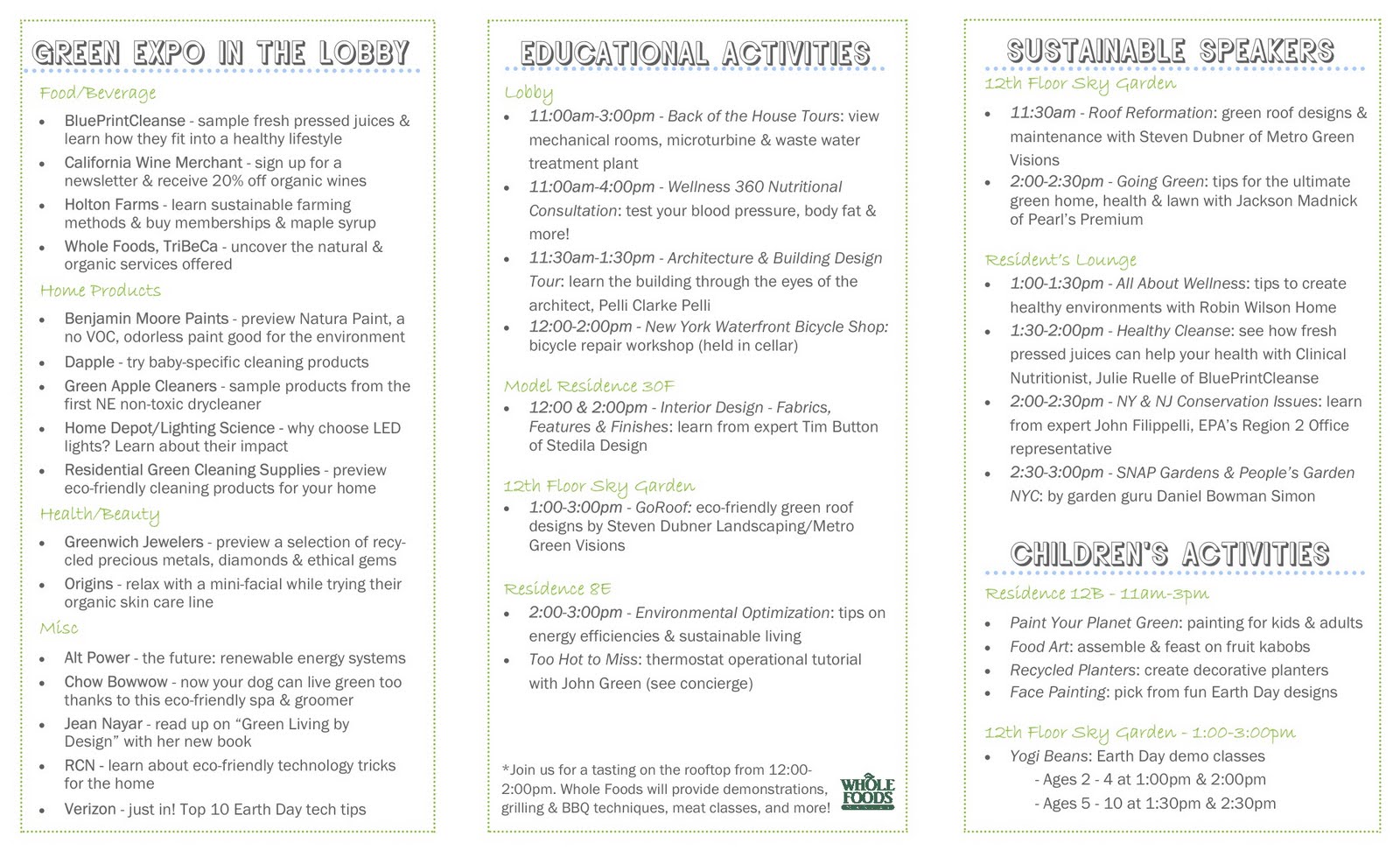
The Visionaire: "The Visionaire Condominium is recognized as being the greenest residential high-rise in the country and has been the recipient of the CNBC Property Award, AIA Building Type Honor Citation and Urban Land Institute Award for Excellence." It is located in Battery Park City, one of the first, if not only, areas of Manhattan to enforce strict green building and renovation codes.
The staff of the Visionaire held this Earth Day Celebration of Sustainable Living and opened it to the public. Vendors had tables in the lobby, speakers presented in common areas on higher floors of the building, there was lunch on the terrace, and attendees were even given the opportunity to take a tour of the eco-friendly operating systems - micro-turbine, air filtration, solar photovoltaic panels, and more!
Overall a great event to showcase the forward-thinking actions of this building, Battery Park City, and the neighboring businesses. I think it's the direction we really need to be heading in.
The event was held on Saturday, April 16 at 70 Little West Street, Battery Park City, NYC, from 11 a.m. to 4 p.m.
www.Facebook.com/TheVisionaire
www.Twitter.com/TheVisionaire
Photos by Michael Toolan.


The staff of the Visionaire held this Earth Day Celebration of Sustainable Living and opened it to the public. Vendors had tables in the lobby, speakers presented in common areas on higher floors of the building, there was lunch on the terrace, and attendees were even given the opportunity to take a tour of the eco-friendly operating systems - micro-turbine, air filtration, solar photovoltaic panels, and more!
Overall a great event to showcase the forward-thinking actions of this building, Battery Park City, and the neighboring businesses. I think it's the direction we really need to be heading in.
The event was held on Saturday, April 16 at 70 Little West Street, Battery Park City, NYC, from 11 a.m. to 4 p.m.
www.Facebook.com/TheVisionaire
www.Twitter.com/TheVisionaire
Photos by Michael Toolan.
 |
| Bradley Fleming of Holton Farms |
 |
John Filippelli, deputy director of the Division of Environmental Planning & Protection for the U.S. Environmental Protection Agency’s Region 2 Office, presents on water conversation and environmental issues affecting New York and New Jersey. |
 |
Jeff DiTaranto of The Albanese Orgnaization, Inc., developer of The Visionaire, gives attendees tours of the building’s green operating systems. |

Wednesday, April 13, 2011
Imagining the Future of Green
This Meetup took place on Monday, April 11, 2011 at 7:00 p.m. at Green Spaces and was hosted by Ethical PR NYC and Carbon Outreach.

This was one of the best conversations I've had recently. The audience ended up being minimal (we finally got some really nice, spring weather), so it became a round-table discussion with the following panelists:
Jesse Ash (@GreenerMedia on Twitter) is an award winning Filmmaker and Partner at Greener Media, a Brooklyn-based multimedia production company that focuses on creating environmentally and socially conscious content. Over the past few years he's helped grow good ideas for the Sustainable South Bronx, New York Restoration Project, Greenpeace Australia, Committee Encouraging Corporate Philanthropy, and a handful of other organizations that are doing good in the world. He can be reached at jesse@greenermedia.com.
Greg Barber (@RecycledPaper on Twitter) is Founder and President of Greg Barber Printing, a prominent environmentally-responsible printer in New York City. Started on Earth Day in 1990, Greg has worked with companies like the NRDC, Earth Pledge Foundation and US EPA.
Helen Clarkson (@hl_clarkson on Twitter) is the US Director of Partnerships & Projects at Forum for the Future. Prior to working with Forum, Helen worked for Médecins Sans Frontières, MSF-UK and at Deloitte's public sector consulting team.
David Marks: has dedicated his personal and professional life to the prevention and remediation of toxic exposures, protecting the health of children and educating others about environmental issues, energy conservation, green living and Jewish responsibilities towards the environment. David is highly experienced in entrepreneurial business development, online marketing, social media and business networking, communications, public outreach, and group organization. He is Co-Founder of Shades of Green Network, a business services and marketing resource network focused on the green industry. He has also founded an internet development firm, The Giving Web, a business networking association, the Dynamic Netowrking Association, and is Chair of the Green Synagogues Committee of his synagogue, Kehilat Kesher in Englewood, New Jersey.
Erica Grigg (@CarbonOutreach on Twitter) moderated a great conversation on the future of green. She is the founder and CMO of Carbon Outreach.
Questions:
1. What strides have been made in the past decade to make you excited about the green movement?

There are mixed opinions on how optimistic we can be on this topic. Some believe that the general public has made great strides toward environmental awareness, but I'm not so sure. Jacquelyn Ottman cites in her new book, Green Marketing, that an astounding 80% of consumers consider the environment before making purchases - this seems incredibly optimistic to me.
I think we all agreed that social media has made incredible strides in the past decade. This can both help the environmental movement and create disinformation as Jessica Reeder commented in the latest Experts' Opinions on Sustainability post. The internet has gone viral providing information, and misinformation, to the masses, improving transparency, and sparking social movements. We commented on 350.org's successful use of social media as well.
 |
| Slacktivism |
But, how much do those Facebook "likes" really matter? Slacktivism has also emerged with the internet - giving people the idea that clicking the "like" button is enough, that they've done their daily duty.
Also mentioned: Earth Excess Day - the day the world uses more resources than it has for that year. (Unfortunately I was unable to find a link to this.)
2. How will the green movement change in the next 30 years?

There is a debate here between which sector will take on the green movement: 1. The People 2. The Government 3. The Corporations.
I believe it is the corporations. Despite the benefits of the small, everyday actions that are being emphasized, it is really larger scale actions we need to be taking. The powers in charge of this are government and companies, and, because so much of the government is controlled by special interest groups and lobbyers, it is the companies that need to take the initiative. We are fortunate to see the current emergence of the CSO - Chief Sustainability Officer - in the corporate ladder, as 2Degrees.com noted in their recent webinar.
There are several unpopular discussions that need to take place to look at the environmental movement over the next 30 years:
1. Population Control
2. Unsustainable Economic Growth [despite what politicians keep saying "grow out economy!" - it's just not sustainable - "you can't have infinite growth on a finite planet."
3. Unsustainable American Lifestyle
We also agreed that the environmental movement is currently fragmented (an idea I have found over and over again, especially in the environmental blogosphere, and the reason I created the EOS project). Websites like 2Degrees are helping bridge this gap, but it is a long road to having everyone working on the same page.
Also mentioned:
Green Schools Alliance
Shades of Green
Participating in the discussion included the following:
Frank Moris of Ecological Advisors
Lauwrence Schaw, Creative Director of Line Works Studios
Mario Vellandi (@MVellandi on Twitter)
John Messerschmidt of Green City Challenge
Greg Barber of Eco Friendly Printer and Neil's Wheels
Bob Leonard, CEO of Earth Garage
Shades of Green
Participating in the discussion included the following:
Frank Moris of Ecological Advisors
Lauwrence Schaw, Creative Director of Line Works Studios
Mario Vellandi (@MVellandi on Twitter)
John Messerschmidt of Green City Challenge
Greg Barber of Eco Friendly Printer and Neil's Wheels
Bob Leonard, CEO of Earth Garage
As always, please leave a comment below with thoughts and questions!
Friday, April 8, 2011
Experts' Opinions on Sustainability - Social Media


What role does social media play in the environmental movement?
Jeffrey Davis - Eco Snobbery Sucks
A huge one. It seems like we're bombarded with information at an ever-increasing rate these days, but I think we're also able to filter that information better than ever as well. For example, I watch, listen to, or subscribe to ANY mainstream media outlets. I choose the news and information I want to be exposed to by what feeds I subscribe to, what twitter accounts I follow, what podcasts I download, and even whose posts I allow to show up on my facebook home feed.
Social media helps us connect with causes that matter to us, and more importantly, other like-minded people who share similar passions. Through those connections I think we can learn and achieve more than we could separately, lone ranger style.
Edward Hall - LghtSrc
An essential role. We need new social media though. Diaspora, the open source Facebook, could provide the platform help people totally get the word out and organize without private interest influence. Programs like groundcrew.us, windowfarms.org, openRTMS.org, they all provide so much value in curbing global warming, empowering people, organizing movements... That's why I've moved on from working on research at Columbia University in sustainable behavior to trying to implement that research entirely in online communities.
When nearly every person on the planet can access something that makes it incredibly powerful. It's time we recognized that power and ALL started building things for the better of humanity. We have to make sure that our online communities are being build through insight and experience we gather in real life though. We have to grow from there and hopefully use the internet to help people get off it, to use MeetUp's saying.
Jin Kong - The Green Elephant
(When you read the following, please note I advocate for a learning revolution through digital media in China, not a political one; I want the Chinese people to use their digital information infrastructure responsibly for the purpose of overall Human Sustainability; while I do not endorse violence as a form of opposition, I do believe there are human rights issues need be addressed in the Chinese criminal defense process related to Sustainability; I simply ask for the Chinese People, a fair and reasonable defense infrastructure to reduce corruption and improve cost efficiency for government programs; got my fingers crossed.)
I consider the “Discussion Boards” that started the violence of the Cultural Revolution in China, and subsequently sent thousands to death and re-education camps (my father included), a form of Social Media. But today, in the US and most of the world, we have a lost sense of social media intricately combined with the powers of the Internet and various computing devices. In much of the US, social media is trendy, high-tech, and sometimes about nothing with significant substance: what did Kim Kardashian have for lunch today?
Social Media, to me, in the truest form, is about bringing people together on a topic and uniting the consensus to overturn the established norms put in place for the benefits of the few, the rich, the careless. Social Media is about using our high-tech devices to generate a collective and existential question we must ask ourselves: where do we see ourselves in the future as a species, a steward of Earth.
There are company sponsored social media/marketing campaigns structured around products or single sided political messages. I call these “Peer Review for Profit” social media, (and these are entirely different from “Social Media” that challenges authorities, overthrows governments, and advocates for those who are voiceless). This type of “Social Media” is part of the established norms for the benefits of the few, the rich, and the careless. This is the kind of social media that influences the masses who stands for nothing, who will fall for anything.
On the other side is the type of Social Media that makes social media sexy and dangerous. This is the kind of social media that exist not for the sake of politics or product sales. This is the Social Media in ListServs of human rights lawyers for China; this is the Social Media in private forums for scientists to discuss their views on Sustainability; this is the Social Media on Twitter that raised over $70,000 for cancer research in one day. This is the kind of Social Media that gives our conversations substance, helps us learn and grow, and get us away from our daily routines to do something good for our society.
I learned from a good friend, Susan Bird, that a conversation can change the world. Many marketing professionals and the so-called social media and marketing companies often miss this very point. Social marketing and viral marketing is effective not because technology has made it so, but because technology made that conversation available. But a conversation is not enough to start a movement. Conversation means nothing if there is no substance and no meaning. The Internet is littered with unnecessary conversations these days. The unfortunate thing is we have wasted so much time paying attention to this useless information. Let’s face the reality: gossips and rants will never solve the challenges we face in world hunger or global warming. I am guilty of frivolous rants and I am working on changing that. What we need is a Method in the Madness. Our job and responsibility is to stop this deterioration and help generate positive learning via Social Media and technology.
So to me, Social Media is not about technology, not about trends, not about meaningless things that does nothing for the Human Experience. To me, Social Media is about a Conversation, about Learning, about making a difference – for our environment and for our fellow human beings; for Earth.
Meris Michaels - Towards Better Health
Calls to action: anti-nuclear groups holding daily demonstrations following the disaster in Japan, forcing countries to rethink the nuclear issue.
Jessica Reeder - Love and Trash
One of the biggest roadblocks for the environmental movement has always been disinformation [false information that is intended to mislead], which often comes from hearsay and punditry. People on both sides of the issues tend to be misinformed, because there are so many differing views on every topic. Particularly while much of the research on climate change, health, nutrition, agriculture etc. is still very much in progress, people don't always know which news sources to trust. Facts seem to shift, and it's hard to know what the "right" answer is -- or if one exists.
Social media allows experts and brands to develop a trusted voice that people feel they can rely on. By offering consistency and good information, by being reasonable and trustworthy, environmental activists are better able to dispel rumors and spread knowledge on important issues.
Unfortunately, this works the other way as well. It's crucial that we remain authentic in our messaging, that we don't fall into extreme viewpoints or logical bogs. Too many news sources rely on sensationalistic headlines and exclusionary moral judgments to pull in more readers; this can easily degrade into publishing bad information for the sake of traffic.
Social media allows experts and brands to develop a trusted voice that people feel they can rely on. By offering consistency and good information, by being reasonable and trustworthy, environmental activists are better able to dispel rumors and spread knowledge on important issues.
Unfortunately, this works the other way as well. It's crucial that we remain authentic in our messaging, that we don't fall into extreme viewpoints or logical bogs. Too many news sources rely on sensationalistic headlines and exclusionary moral judgments to pull in more readers; this can easily degrade into publishing bad information for the sake of traffic.
Brendan Seale - The Interconnectedness of Things
Social media accelerates our collective shift to a far more transparent world. Traditional media outlets can be laden with associations that prevent true, unbiased, and unfiltered reporting and opinion, but social media provides access to information from a wide variety of sources and and gives engaged citizens a voice. It does not only facilitate transparency; it also increases the demand for it.
Heightened transparency is ushering in a new paradigm in which citizens are increasingly aware when a business interest is in some way at odds with the public interest. The "environmental movement" and the notion of sustainability benefit from this type of information sharing because it creates an increased understanding of the true interconnectedness of our world. It encourages all parties to rethink our our notion of value, and to pursue value in ways that do not diminish value elsewhere or in the future.
Shane Shirley-Smith - Environmental Booty
You hear it everywhere these days, social networking through the use of social media is a must for every business. Why should it be any different when it comes to sharing the green message? What is the environmental movement anyway? Isn’t it just a bunch of individuals who, when they are able to come together and connect, can use their collective power to create change? Social media has made the connection part of the change equation as easy as turning on the computer. From blogging, YouTube, Twitter, Facebook, LinkedIn and every niche community site in between, people have seemingly unlimited opportunities to connect with others who are as passionate about sustainability as they are.
I think the question which should be asked is not to what role social media has in the environmental movement, but what role do you have in using social media to create the change you want to see. Do you want to start a blog to share all you are learning on your walk to green living? Why not hop on YouTube and check out the latest vids from your favorite non-profits? Do you want to use Twitter to get up to the minute information on issues like alternative energy use and ways to live greener? How about jumping on Facebook and joining local environmental groups or laying down links you find in your daily web searching? Corporate executive gatekeepers have been replaced with Twitter @mentions and if you want your message to reach the highest on the corporate ladder, social media is your friend. Social media has made it easy for greenies to make important connections and form partnerships which, just a few years ago, were difficult to create.
Thursday, March 31, 2011
Fair Trade Event

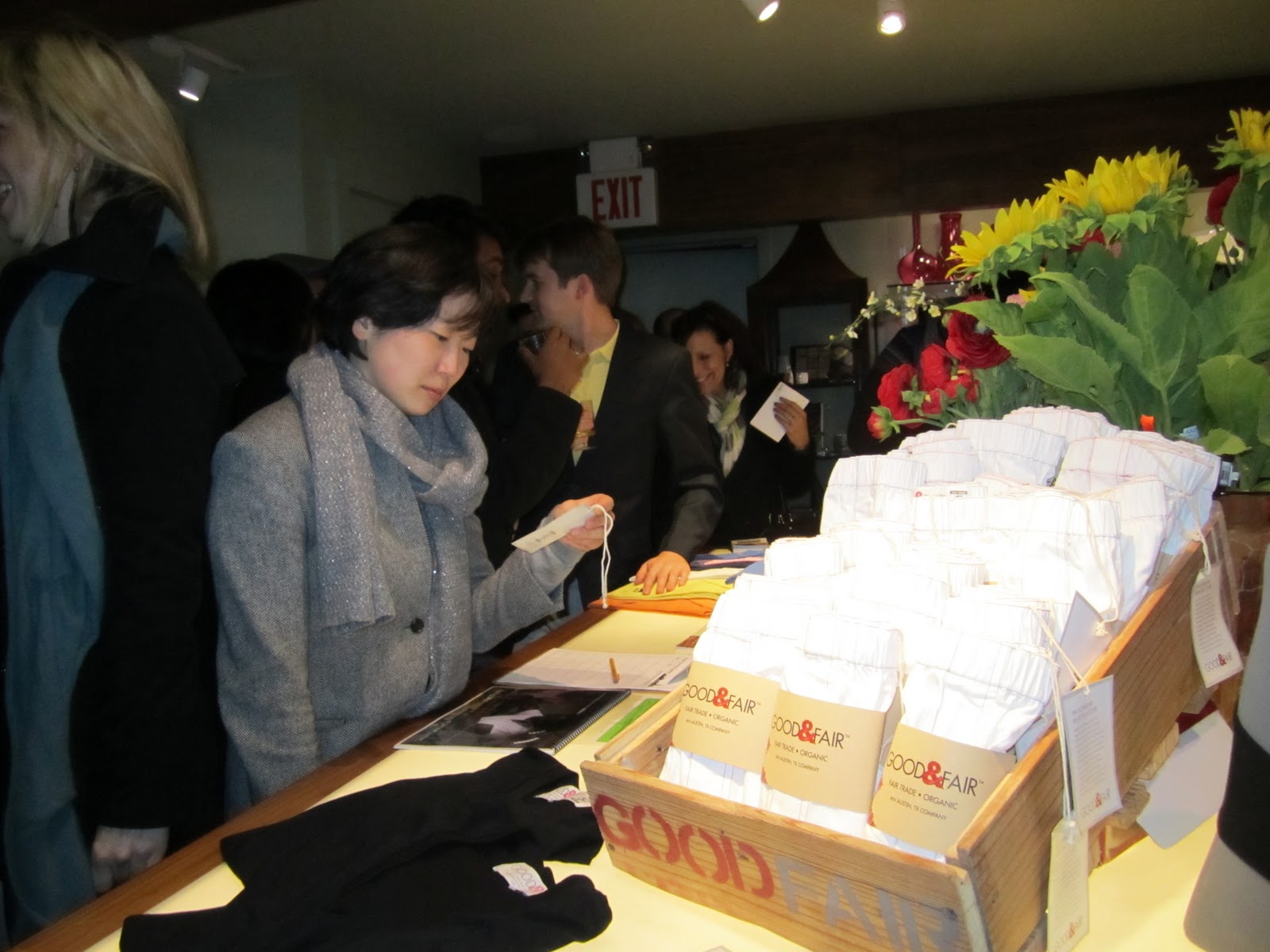
It was a great event that united fair trade companies with consumers.
About the NYC Fair Trade Coalition: NYCFTC is an all volunteer grassroots organization educating consumers on fair trade and promoting fair trade businesses in NYC. They support and promote discussion around issues of Fair Trade with speaking engagements and events. The event also served as a kick-off for their new "Look Book," which describes the businesses in the coalition. They are currently in the process of mapping stores that sell fair trade products in NYC. You can visit their facebook page here.
________________________
About Arcadia: I have included quite a long description of the store because I found their ideas and values incredible noble and important. You can read the rest of their description on their website.
After many years of running other people’s businesses, learning how different types of businesses functioned (or didn’t) and realizing that I would never be truly happy working for someone else, I decided to go out my own….“Simple is beautiful” was my response to the complicated, difficult, hectic lives many New Yorkers, myself included, live on a day to day basis. I look for clean lines, functionality, beautiful design, unique product, at reasonable prices that are ethically made. I aim for a broad enough selection that most people can find exactly what they need while still maintaining a sense of continuity throughout the store.
"...While the highest ethical conduct may not always pay off financially, it always pays off in far more important ways."
...I had the tag line “simple is beautiful” set in my head, but was rather lost on what to actually call the store….Thankfully, my best friend immediately suggested Arcadia, from James Joyce’s “Ulysses” which he was reading at the time. I immediately loved it; it is graphically balanced, begins with an A (important for phone and web listings), and most importantly, the Oxford English Dictionary definition of Arcadia is “a simple, pastoral way of life. Heaven on Earth”. Clearly, it was meant to be.
Arcadia’s core values We strive to offer our customers a peaceful, pleasant shopping experience where our customers will find helpful, friendly employees who are attentive, informative and knowledgeable about the products we offer. It is important to us that everyone feels welcome and comfortable at Arcadia, regardless of their budgetary constraints or interest in purchasing anything at all. We aim to be patient, helpful, respectful and polite to everyone, and hope for the same from our customers.
Arcadia focuses as much as possible on fairly traded products made throughout the world, so that our customers’ interest in supporting indigenous populations and their cultures can be achieved. We also try to limit our impact on the environment in the following ways;
- We recycle as much of the packaging materials we receive from our suppliers as possible by reusing them for our own shipments, as padding for gift packaging, offering free packaging materials to customers who can use them, and paying for recycling of our own garbage. We also regularly lobby our suppliers for greener packaging solutions, referring companies to each other so they can share information on reducing their packaging. We routinely ask customers who already have shopping bags if they would like to skip a bag for their purchase at Arcadia, although we happily supply shopping bags for all purchases regardless of size.
- Arcadia uses 100% wind energy for electricity, through the Con Edison Green Solutions program. Our track lights are a special infrared variety that reduces their energy usage approximately 20%. We also use LED and fluorescent lighting where ever feasible. The entire façade of the store uses double paned, insulated UV glass, specifically designed to reduce heat transfer as well as noise, which reduces our need for air conditioning in the summertime and insulates us so well from the cold in winter that we rarely run the heat in the winter. Our electronic thermostat is programmed to keep the store at a mild 73 degrees all day during the summer, at 74 during the winter, shuts off automatically when the store closes at 10PM, turning on in the morning just in time for opening. Because natural gas dryers are more efficient than electric dryers, we use gas for our dryer, which along with our washer is EnergyStar rated. We also try to run our appliances with larger, therefore more efficient, loads later in the evenings when energy demand is lower.
- We have resisted the retail trend towards plastic coated, heavy shopping bags. While we understand that many customers reuse such bags, they are non-recyclable due to the multiple layers and materials involved. Our paper bags are made of 30% post consumer waste and are recyclable with other paper products. We offer plastic bags (saved from my grocery shopping at Gristedes) only during heavy rainstorms as needed to protect our customers’ purchases from the elements. Our gift boxes are made from 100% recycled paper and are recyclable, as are our tissue papers and heavy craft paper. The fancy gift wrap, while not made of recycled papers, are recyclable. We are currently investigating switching suppliers for our jewelry boxes to a Rhode Island based company which uses 100% recycled materials to replace our current suppliers which are based in China and are mostly non-recycled and only partly recyclable.

THE VENDORS
Ahkun
Blog Twitter Facebook
About: Ahkun means 'thank you' in Khmer (Cambodian). We work with entrepreneurs who have received microloans to further their skills and build better lives for themselves, their families, and their communities. We connect them to the global marketplace---creating sustainable businesses and closing the gap between microfinance lenders and borrowers, consumers and producers.
Fair Trade Spirits
About: FAIR. announces the rise of transparent and sustainable ethics in ultra premium spirits. By associating the best French distillers to local cooperatives in the third world, FAIR. aims at bringing to the consumers the finest spirits possible produced from fair-trade ingredients. We believe in showcasing in the most transparent way all the human capital that goes into making unique ultra premium spirits.
In 2009 the Fair Trade Spirits Company launched FAIR. Quinoa, the first Quinoa-based Vodka but also the first fairtrade certified™ vodka in the world. FAIR. Quinoa has been awarded twice last year as one of the best Vodka in the world. In 2010 they completed the line with FAIR. Goji made from the legendary, sacred Goji berry fruit. FAIR. Goji is the first Goji Berry Liqueur and is fairtrade certified™. FAIR. offers the latest sources of inspiration for fresh, healthy and generous cocktails.

Global Goods
Blog Twitter Facebook
About: Global Goods Partners is a not-for-profit organization dedicated to empowering women, alleviating poverty and promoting social justice. We partner with community based organizations in marginalized regions of Asia, Africa, the Americas and the Middle East, creating access to the U.S. market for our partners’ handcrafted products and providing technical assistance to build sustainable livelihoods.
Itzso
 |
| The models sported apparel from multiple vendors. |
Kono (Google Translate English Version)
Blog (English) Facebook
About: Kono Business is a business concept that aims to tailor marginalized women in Sierra Leone produce scarves and handbags designed by Danish designers.
Of Rags
Blog Twitter Facebook
About: Of Rags is a fair trade fashion cooperative for sustainable community development. 40% of the profits from each sale directly support public health and education initiatives. The remaining proceeds are used to grow the company to achieve the greatest impact.
Tompkins Point Apparel
Blog Twitter Facebook
About: TOMPKINS POINT APPAREL is a unique brand dedicated to ensuring that every person who plays a role in producing our clothing has a better life because of our business. To do this, our clothes are certified fair trade and organic and we donate 25% of our profits directly to the people who make our products. We're proud of our shirts and what they represent, and we'd love for you to take the time to learn more about us.
 Via Nativa
Blog Facebook
About: After seeing the talent and abundance of artisan crafts in Nicaragua, and understanding that it is not only an art but very much a livelihood, Alessandra Plasa and Vanesa Natale started a fair trade and environmentally friendly business. Alessandra now runs the business with a focus on sustainable wood jewelry among other accessories and works directly with artisans and women owned co-ops in Nicaragua.
___________________________________________
Questions for Consideration
The following commentary is a combination of my own ideas and those expressed to me by other attendees of the event.
1. How useful and reliable can third party certifiers (like Transfair) be for verifying and marketing the fair trade fashion industry?
Overall: Very helpful.
Despite varying criteria for these certifiers, they are helpful in educating consumers about products and in starting a discussion. Jay, the owner of Arcadia, told me that third party, and even second party, certifiers are better than nothing and mean that we're moving in the right direction. We have seen these certifiers pop up in many industries, and they were also a topic for discussion at the SPN Panel on Green Consumerism and the Slow Fashion Meetup.
NYC FTC is in the process of creating an online database for stores that sell fair trade products, and their own seal of approval. This event was a show case for their new "Look Book," a collaboration by the sellers of NYC FTC to raise awareness about their products.
Fair trade products do, sometimes, cost more than others. As described in The Story of Stuff by Annie Leonard and The Trust Cost of Food by the Sierra Club, some of the products we buy are impossible cheap, meaning that the real cost is not put on us but on other countries, cultures, and the environment.
3. How [much] can pressure from social media and potential publicity from Corporate Social Responsibility campaigns help grow the Fair Trade industry?
Overal: Immensely
Social media, and the internet in general, provide a vital information source for discovering supply chains and then spreading the information about irresponsible practices. Sustainability and fair trade practices are now being used as marketing tools by companies, and are slowly being demanded by the customer and employees.
I have found a general shift between businesses and organizations to a middle ground. Businesses are using fair trade standards to create positive change, and organizations use a business model to increase revenue. I imagine that this will now become a growing trend, in which companies move to look more at the triple bottom line. Most of the companies represented at the event have a large charitable component to them. Of Rags has a very interesting situation in which they have both company and 501c3 status to work in both sectors.
4. How can the fair trade and slow fashion industries combine to increase purchase of sustainable clothing items?
Both the fair trade and slow fashion industries are working to reduce our overly consumeristic mentality and increase our appreciation of materials and where they come from. They are similar movements, although focusing on slightly different areas. They both represent ideas that are crucial to developing a sustainable culture and civilization.
5. In a time when consumers are growing further and further from the source of their purchases and where they go once they are thrown out, how can be we bring people back to look at all levels of the supply chain?
Both the slow fashion and fair trade industries are working to increase awareness of the supply chain. Websites like sourcemap.com and third party certifiers are also working toward this end. Our current mentality of materialism is a relatively recent development but will take time to move away from. Increased awareness about where all of our things come from and go once they are disposed of will help customers "vote with their dollar" for responsible items.
6. How is the U.S. doing in relation to the rest of the world on the mission of Fair Trade? How do different cultures react to the concept?
I heard mixed opinions on this topic. Some say that the U.S. is behind the EU in terms of awareness of fair trade and the source of products. Others say we are keeping up. I believe we are behind. America's mentality has always been freedom and materialism. The freedom aspect gives many the excuse to say that they will buy which ever products please them (in a slightly entitled way often). The materialism aspect can be easily seen in the ideal of the American Dream - owning a home [and competing against our neighbors for "more stuff"]. Cultures that have more of a history of slowing down, such as Italians with their ideal of Dolce Vita, are, in my opinion, more receptive to these fair trade and slow fashion movements.
I will repeat one of my favorite quotations from the documentary "The Economics of Happiness":
"You cannot have infinite growth on a finite planet."
It is essential to keep this in mind when moving toward a more sustainable culture.
Now it's your turn to weigh in: What do you think about the questions above and the fair trade movement? Do you have any favorite fair trade stores?
Friday, March 25, 2011
Experts' Opinions on Sustainability - 2010 in Review
With this first post of EOS, we can look back on 2010 and get to know our experts a little better as well. Enjoy! And please leave any comments below.
Question Set #1: 2010 in Review
1. I'm not one of those environmentalists that gets involved in politics...as a matter of fact, I don't even vote. For me, not voting is my vote. I don't really see where one person (or group of people) lording over others has ever worked out so well for any party involved...including the environment. Bare in mind that is simply my personal political paradigm, but that's how I see it for now.
I think we'd all be much better off if we'd learn to love and respect each other, and in turn, the environment we live in. It may sound idealistic, but if we can't cling to ideals, what hope do we have to begin with, ya know?
1. I refrain from speaking about politics because I believe this is beyond any one person and beyond politics in general. I believe this Sustainability, or Green movement is about a life style that affects other human beings and other life. I consider it a humanistic question. Although politics is very much part of the issue, but I feel it often clouds the real questions.
 These three books gave me the knowledge base necessary to appreciate the complexity of the Green issue, the immense knowledge gap we have about the Sustainability topic, and the invariable connections between how we see ourselves, how we see the world, and how we see changes, that shapes our Sustainability crisis. Of the three authors, each brings a sense of professional quality to what they can contribute to the overall Green Conversation. I see them as my teachers and their writings the lighted guideposts on my journey to changing my own behaviors. Aside from these books, I want to also mention The Economist’s Special Report on Food, the 9 Billion People Problem. The editors at The Economist really put the problem in perspective and gave the context necessary to frame my own thinks.
 2. Poisoned for Profit - How Toxins are Making our Children Chronically Ill by Philip & Alice Shabecoff, revised 2010 edition, describes the devastating effects of toxic chemical substances on children's health and includes advice to parents and consumers on how to advocate for a healthier environment.

 2. Temple Grandin's "Animals Make Us Human." I devoured every word. It gave me so many tools for understanding not only the animals I interact with (by keeping, feeding or eating them), but myself and other humans as well. It's incredibly clearly written and has completely changed my mind on some subjects.
2. My favourite book of 2010 was "Strategy for Sustainability" by Adam Werbach (ok fine, it was released in 2009). Werbach eloquently makes the case that sustainability cannot be thought of as window-dressing, reputation management, or a "nice to have", but is actually about an organization's long-term viability and survival. He provides a great approach for recognizing threats and opportunities, and then highlights the need for transparency, engagement, and networking to make meaningful progress.
2. Farmer Jane - Women Changing the Way We Eat by Temra Costa
3. Garbage Dreams - PBS Independent Lens Series by Mai Iskander
Believe me when I tell you, Garbage Dreams by Mai Iskander, part of the PBS Independent Lens Series, should definitely be a part of your PBS education.
Bonnie Lane Weber – Grass-Roots Organization
2. A Better Way of Dying by Fitzpatrick and Fitzpatrick. Population control is a very important environmental issue. Acceptance of dying is an important part of population problem and will help save our resources. We should not be keeping people alive many of whom do not even know they are alive. We must do paperwork to prevent our being kept alive longer than we prefer.
3. Gasland not because it is a prize documentary as a film but because it is a prize education tool. It has made many people around the country aware of the dangers of hydrofracking. It is a very important part for NY State being able to get such attention to the issue that maybe it can be stopped or at the very least made safer.
Now it's your turn:
What was the biggest political upset in 2010?
What was your favorite book of 2010?
What was your favorite documentary of 2010?
Question Set #1: 2010 in Review
1. What was the biggest political upset of 2010?
2. What was your favorite book of 2010?
3. What was your favorite documentary of 2010?
Jeffrey Davis - Eco Snobbery Sucks
1. I'm not one of those environmentalists that gets involved in politics...as a matter of fact, I don't even vote. For me, not voting is my vote. I don't really see where one person (or group of people) lording over others has ever worked out so well for any party involved...including the environment. Bare in mind that is simply my personal political paradigm, but that's how I see it for now.
 |
| Credit: Amazon.com |
2. I didn't read much in 2010. Well, at least not in the form of books. But of the books that I did get to read, 50 Things Your Life Doesn't Need, by my friend Sam Davidson was my favorite...and not because Sam is a good friend. It's truly a great read!
3. I'm not much of a film documentary type person. I LOVE the History and Discovery channels, and watch lots of documentaries (if you want to call them that) there, but don't catch many film documentaries. I have been planning to finally see The Cove.
Brendan DeMelle - DeSmogBlog
Brendan DeMelle - DeSmogBlog
1. Russ Feingold's loss to Ron Johnson
2. Merchants of Doubt (Naomi Oreskes and Erik Conway)
3. Tie between Gasland and The Cove
2. Merchants of Doubt (Naomi Oreskes and Erik Conway)
3. Tie between Gasland and The Cove
 |
| http://www.sonyclassics.com/insidejob/ |
1. The UK "hung parliament", quite a lot of ruckus there!
Jin Kong - The Green Elephant
 |
| Credit: Amazon.com |
2. Michael Pollan’s The Omnivore’s Dilemma;
Jonathan Nash’s Environmental Law and Policy; and
Dr. Colin Campbell’s The China Study.
 These three books gave me the knowledge base necessary to appreciate the complexity of the Green issue, the immense knowledge gap we have about the Sustainability topic, and the invariable connections between how we see ourselves, how we see the world, and how we see changes, that shapes our Sustainability crisis. Of the three authors, each brings a sense of professional quality to what they can contribute to the overall Green Conversation. I see them as my teachers and their writings the lighted guideposts on my journey to changing my own behaviors. Aside from these books, I want to also mention The Economist’s Special Report on Food, the 9 Billion People Problem. The editors at The Economist really put the problem in perspective and gave the context necessary to frame my own thinks.
3. As for my favorite documentary is ZeitGeist: Moving Forward. Beware, the whole thing is close to three hours long, but even if you just watch the first three minutes of the video, you will be inspired!
 |
| www.ZeitgeistMovie.com |
Meris Michaels - Toward Better Health
1. The Republicans gaining more seats in Congress and entry of Tea Party members into the government.

3. "Solutions locales pour un désordre global", 2010 French documentary produced by Coline Serreau. In contrast to the "global disorder" of intensive industrial agriculture, the film presents "local solutions" for a more sustainable agriculture such as direct delivery of locally-grown produce to consumers; setting up seed banks to preserve plant diversity and move away from the expensive patented GMO seed imposed by multinationals; producing a healthier soil, free of chemical fertilizers and pesticides.
Jessica Reeder - Love and Trash
1. In the United States: The Arizona immigration law. Obviously the issue is contentious, and it's been debated for a long, long time. This law is simply another step on a long path with a pretty clear destination: to hold back immigration to America.
I try not to buy into the political divisions in our country, but rather look at both sides of the issue. Immigration is something that every country struggles with, but over the centuries America has often prided itself on its open borders. I think this move to impede illegal immigration speaks to America's growing maturity as a nation. Personally I don't agree with the law for a number of reasons, but I find it very telling.
Internationally: The Tunisian Revolution. I know its effects were largely felt in 2011, but this revolution's impact was bigger than almost any other event in 2010. It sparked popular uprisings around the globe, something that (to my limited knowledge) has never happened before in such a way and is very much related to Internet accessibility. This is a clear sign that humanity's increased access to knowledge and communication tools will irrevocably change the relationships between governing bodies and their citizens.

 2. Temple Grandin's "Animals Make Us Human." I devoured every word. It gave me so many tools for understanding not only the animals I interact with (by keeping, feeding or eating them), but myself and other humans as well. It's incredibly clearly written and has completely changed my mind on some subjects.
3. I don't really keep up with the movies, but I did attend the Wild & Scenic Film Festival in January. I loved Bag It and have recommended it to lots of people. I also got a real kick out of a short called On The Trail With Miss Snail Pail.
Brendan Seale – The Interconnectedness of Things
1. In my opinion, Naheed Nenshi's victory in the mayoral race in Calgary, Alberta ranks as the biggest political upset of 2010. Nenshi trailed in the polls and languished in third place as ballots were being cast. But he ran a very clear, thoughtful, innovative (lots of social media), and sustainability-driven campaign right in the heart of the Canadian oil economy's territory and managed to emerge victorious. He highlighted errors made by previous city councils and made clear how he would address them and create a better future in ways that made sense fiscally, socially, and environmentally. His message certainly struck a chord with Calgarians.
 |
3. Gasland ranks as my favourite documentary of 2010. Hydraulic fracking for natural gas is obviously very risky business, and is not being regulated with nearly an appropriate level of caution. The film is an excellent example of our reckless pursuit of a certain type of progress, our extremely short-term view of success and the consequences of the decisions we make, and a failure of governing bodies to put the wellbeing of their people before corporate interests.
Shane Shirley-Smith - Environmental Booty
1. I was just thinking that the answer to the biggest upset should just simply be the approval of Obama Care. The two advisers I referenced in the post, are no longer a part of Obama’s adviser team. As a registered Democrat who no longer automatically votes along party lines, I am appalled at what President Obama's advisers on health care are planning to do with our lives. Are you? Part of living a green lifestyle is about not only keeping an eye on the future health of our planet, but also looking out for the future health of each and every one of us. Obama's health care plan is certainly turning me green...as in the color you turn before you puke.
You can check out the rest of Shane's blog post on the topic here: http://shaneshirleysmith.blogspot.com/2010/09/americans-do-you-really-know-what.html
 |
| www.FarmerJane.org |
Not only do I love Temra Costa's book because of the 30 stories of inspiring women changing the way we eat, I also love it because it was a transformative read. I asked Temra Costa why she wroteFarmer Jane and she said, "Because women's stories need to be told. Also, I wrote it to educate and inspire action and change in our food system."
There are so many great tips on how a woman (or a man) can find easy ways to provide her family with healthy, whole, local and sustainable foods, that I came away from reading the book with a feeling that I can and should feed my family better foods through knowing my farmer, protecting my local farmer's way of life and supporting locally sourced food production.
Each of the books chapters focuses on the areas of change that women are leveraging to bring greater sustainability back to our plates. Every chapter features profiles of women and ends with "Recipes for Action" which give actionable steps to help us follow through with the concepts discussed - ideas for how you as a farmer, eater or an owner/employee of a food business can join in.
We can "vote with our fork", as Temra says and truly change the future of not only agriculture, but our future generations as well.
 |
| www.GarbageDreams.com |
Believe me when I tell you, Garbage Dreams by Mai Iskander, part of the PBS Independent Lens Series, should definitely be a part of your PBS education.
For those of us living in a country such as the United States, you will see firsthand just how really far behind we are in our efforts to Reduce, Reuse and Recycle. If you have children, this is a must see as it will solidify in their minds, just how much of a difference young people can really make, and what a significant impact can be made with their knowledge and resulting power.
The movie was filmed over four years in Cairo and follows three teenage boys who are “Zaballeen” which is Arabic for “garbage people”. The Zaballeen have collected Cairo’s garbage for decades in a way that is far ahead of any of our modern green initiatives. They recycle an almost unbelievable 80% of the garbage they collect while lifting themselves out of poverty and creating a solution to one of the world’s most pressing crisis. When the Zaballeen community is suddenly faced with the globalization of its trade, each of the teenage boys is forced to make choices which will impact their future and the survival of the community.
The movie was filmed over four years in Cairo and follows three teenage boys who are “Zaballeen” which is Arabic for “garbage people”. The Zaballeen have collected Cairo’s garbage for decades in a way that is far ahead of any of our modern green initiatives. They recycle an almost unbelievable 80% of the garbage they collect while lifting themselves out of poverty and creating a solution to one of the world’s most pressing crisis. When the Zaballeen community is suddenly faced with the globalization of its trade, each of the teenage boys is forced to make choices which will impact their future and the survival of the community.
1. Trite at this point but it is the success of the Tea Party because they now have a lot of power. Also, not political, but the fact that Bernie Madoff was the only "banker" that wound up in jail.
 |
| Credit: Amazon.com |
 |
| www.GaslandTheMovie.com |
3. Gasland not because it is a prize documentary as a film but because it is a prize education tool. It has made many people around the country aware of the dangers of hydrofracking. It is a very important part for NY State being able to get such attention to the issue that maybe it can be stopped or at the very least made safer.
Now it's your turn:
What was the biggest political upset in 2010?
What was your favorite book of 2010?
What was your favorite documentary of 2010?
Subscribe to:
Posts (Atom)